

Today we’re talking about something that has been bothering me for years, something that used to be a side-note of modern culture but has now grown into a full, shiny, glamorous, industrial monster: our sick obsession with turning every disgrace, every scandal, every collapse of moral character into entertainment. Something awful happens, someone in power gets caught doing something they absolutely should not be doing, and before the dust has even settled someone, somewhere, is already negotiating a book deal and asking about lighting setups for the documentary. It doesn’t matter how serious the crime was. It doesn’t matter who was hurt. It doesn’t matter if the whole thing exposed a deep rot in the system. As long as the story is messy and the person involved is even vaguely recognisable, it’s not a tragedy anymore – it’s content.
And the thing that really does my head in is that it’s not just an accident of the media cycle. It’s now a cultural reflex. One person says: “Can’t wait for the Netflix documentary!” And then everyone laughs, because everyone knows it’s true, and because everyone secretly thought it too. It’s a modern version of gallows humour, except instead of coping with tragedy, we’re pre-ordering the entertainment rights. We don’t mourn. We don’t reflect. We don’t ask how the fuck something that awful was allowed to happen.
This isn’t just about celebrities. It’s not even just about politicians. It’s this entire mental model we’ve built where the worst moments of someone’s life, or more specifically the worst actions of someone’s life, become public snacks. We watch their downfall like we’re watching a nature documentary. We pick apart their motives. We replay their errors. We consume the whole thing the way we consume crisps – mindlessly, without thinking about what it does to us. And then we pretend we’re shocked when the person at the centre of the mess turns around, wipes their face, and uses the attention to sell a product. Why wouldn’t they? The machine makes it so easy.
Which brings us neatly to Nicolas Sarkozy – and I want to be very clear here that I’m not picking on him because he’s unique. I’m picking on him because he’s the freshest, clearest example of the rot. A former French president, a man who held real power, convicted of crimes that strike right at the heart of democratic integrity. Not some slap-on-the-wrist offence. Not a parking ticket. Not a bit of “creative accounting.” He was convicted for criminal conspiracy involving illegal campaign financing linked to the Gaddafi regime. He was convicted for massively overspending his 2012 campaign – an eye-watering €43 million, nearly double the legal limit – hidden under fake invoices. And he got a custodial sentence that any normal person, anyone without a famous face and a political legacy, would have had to serve in full behind bars.
Except of course, that’s not what happened. He did twenty days in La Santé, a prison so cushy by normal standards that calling it “harsh” would be an insult to anyone who has ever set foot in an actual cell. After twenty days, he’s out under judicial supervision and somehow, as if by magic, the story shifts from “senior politician implicated in deeply serious corruption” to “man emerges from hardship with reflections to share.”
And that’s the thing that should worry us. Not just that he got off lightly – we know how power works, we know that the justice system bends depending on who you are and who you know. The part that should worry us is how smoothly the whole thing was repackaged. How easily a man who should be reflecting privately on the damage he helped cause – to democratic trust, to public confidence, to the idea that elections should not be funded by murderous dictators – can instead step out into the world with a bloody book deal. A prison diary. Twenty days of mild disruption transformed into literature.
This is where what I’ve coined the Disgrace Industry comes in. We’ve created a culture where consequences aren’t consequences – they’re material. They’re branding. They’re opportunity. If you are powerful, and you get caught, the punishment is just the transitional phase between the scandal and the comeback. The whole thing follows a rhythm that has become so predictable it might as well be printed on a mug.
A scandal breaks. The public reacts. The lawyers send statements full of words like “regret” and “context” and “misunderstanding.” Then the PR consultants take over and start smoothing the edges. Soon enough, the whole thing becomes a “moment” in the person’s life rather than a breach of trust, a crime, or an ethical disgrace. And by the time you’ve processed how serious the original behaviour was, you’re being invited to consider the emotional journey of the person who did it.
What emotional journey? You were convicted of criminal misconduct. The journey is supposed to end with accountability, not a launch party.
But this is the world we’ve built. Normal people suffer real consequences: jail time that wrecks their prospects, criminal records that hang over them for years, financial fallout that takes lifetimes to repair. But people with status, with followers, with a Wikipedia page, get treated like their wrongdoing is not wrongdoing but a storytelling opportunity. They don’t get exiled from public life – they get reintroduced with a soft piano soundtrack.
And what’s worse is how aggressively we’ve normalised the whole process. There’s no shock anymore. Seemingly no sense of “hang on, this person did something genuinely fucked, maybe we shouldn’t be celebrating their introspection.” We just roll out the carpet. Publishers queue up. Journalists smile for the exclusive. Talk shows prepare the comfy chair and the glass of water and the sympathetic nods. And slowly the whole thing shifts from “this was a crime” to “this was a challenge.”
These people in power treat their punishment as a character-building subplot in a prestige miniseries, and we let them.
We sit back and let a man like Sarkozy, convicted of genuinely serious offences, present twenty days in an extremely manageable prison environment as some profound moment of reckoning. It’s insulting. It’s insulting to anyone who has ever faced actual hardship. It’s insulting to the people who believed in the political process he helped undermine. And it’s insulting to the idea of justice itself.
And yet, you know what’s coming. You know how this will go. There will be interviews where he talks about solitude and reflection. There will be articles about how prison “changed him.” There will be fawning questions about what he learned, and whether he feels misunderstood, and whether the experience gave him new perspective. And inevitably, they’ll spin it as “growth,” as if anyone needs emotional maturity to grasp you shouldn’t take dirty foreign money to win an election.
Growth? He didn’t discover a cure for cancer. He didn’t transform a community. He didn’t put right the harm. He spent twenty days in a cell that has cleaner tiles than the average NHS bathroom. The only thing that grew was the publicity budget.
But this is the world we’ve created: a world where disgrace is not a dead end but a pivot. A world where being caught doesn’t diminish you – it enhances your marketability. Because disgrace sells. Scandal sells. Shame sells. And the people who run media companies, publishing houses, streaming platforms – they know it. They don’t care about justice or ethics or victims or the credibility of public institutions. They care about engagement metrics and money.
And this is the point where we have to talk about ourselves, because this is not a problem that exists in isolation. It’s not like there are two or three evil companies rubbing their hands together in a dark room. No, this is a whole ecosystem, and we are feeding it. We keep clicking on these stories. We keep watching the documentaries. We keep buying the books. We make the market. And the market responds.
We’ve conditioned ourselves to seek out disgrace because it’s one of the few things that still cuts through our endless numbness. We are overstimulated, bored, constantly flicking between apps, constantly searching for something intense enough to make us feel something. And the downfall of a powerful person – that makes us feel something. It gives us the thrill of seeing a giant fall. It gives us the comfort of thinking, “At least I’m not that bad.” It gives us a moral sugar rush.
But there’s another reason we watch this crap. It’s because it’s easy. It asks nothing of us. You don’t have to fix your life to watch someone else’s fall apart. You don’t have to confront your own failures to mock someone else’s. You don’t have to engage with the real, complicated parts of politics and ethics and civic life. You just binge a neatly packaged series with a dramatic score and a few well-edited interviews. And then you go to bed thinking you’ve learned something, when all you’ve done is consume someone else’s disgrace like junk food.
And the media knows this. Of course it does. The media figured this out years ago. That’s why every scandal gets turned into an emotional arc within forty-eight hours. It’s why newsroom editors talk about “audience resonance” instead of responsibility. It’s why morning television hosts smile warmly at people who should be answering serious questions. And it’s why teeny tiny production companies pop up like mushrooms after rain, ready to pitch “the definitive documentary” on whatever awful thing happened last week.
You can see it in how we treat court cases too. Trials used to be solemn. They used to be about truth, justice, the public understanding of wrongdoing. Now they’re set pieces. They’re part of an unfolding narrative that audiences consume over breakfast. You get live tweets, slow-motion replays of the accused walking into the building, frenzied speculation about what the body language means. We’re not looking at justice anymore – we’re looking at season two.
And then there are the victims. The people the crime actually hurt. The people who lost money, stability, time, family, trust. In the Disgrace Industry, they’re afterthoughts. They get a few minutes of solemn music, a few clipped sentences, maybe a tearful moment if the editor wants to pull the heartstrings. But they’re not treated as human beings with lives upended. They’re treated as narrative devices – emotional seasoning to give the arc some depth. And once their moment is over, we cut back to the perpetrator talking about their journey. Because, apparently, their feelings matter more.
It’s repulsive. It’s morally backward. It’s everything wrong with a culture that has traded seriousness for spectacle.
And it all contributes to the most dangerous part of this whole mess: powerful people are no longer afraid of consequences. Why would they be? If you know that even the worst moment of your career will be turned into a commercial opportunity, why worry? If you know that your crimes – your actual crimes – can be reframed as personal growth, why stop? If you know that the public will eventually get bored and then welcome you back if you show the tiniest hint of humility, what are you afraid of?
People in power have figured out that disgrace isn’t fatal. It isn’t even that painful. It’s just the bit you have to get through before you can monetise the comeback. That is why this industry is so poisonous. Not because it offends our sensibilities, but because it distorts incentives. It tells the powerful that the worst thing that can happen to them is not jail or shame or permanent exclusion, but a slight delay before the book tour.
And if you think I’m exaggerating, look around.
Take Matt Hancock – the poster boy for how little consequences mean now. The man broke the rules he wrote during a pandemic, snuck around with his aide while people were dying alone, and somehow his next stop wasn’t disgrace or exile, but a spot on I’m A Celebrity Get Me Out Of Here, where he got to giggle his way through bushtucker trials and cash in on fake-as-fuck tears. And once you’ve seen that, you suddenly notice the whole ecosystem: footballers walking straight back into multimillion-pound careers after behaviour that would collapse any normal person’s future. Presenters strolling back onto comfortable sofas after leaving chaos behind them. Politicians go off the rails, then return as commentators. Fraudsters sink companies, then reappear as “business gurus.” Influencers run scams, then come back with “mental health journeys.” And now Sarkozy, a former president convicted of corruption, trots out of a twenty-day prison experience with a diary that is presumably meant to lift the veil on his suffering. The details change, but the pattern doesn’t. They all know the drill. They all know it works. And they’re all laughing their arses off at you – the ever-forgiving public who keeps taking them back as if nothing happened. If the system lets you turn your own wrongdoing into intellectual property, then the system is no longer a system of accountability – it’s a marketing funnel.
So what do we do? What is the fix? Because if the answer was simply “shout about it,” I’d be done already.
The fix is boring and simple and completely within our control: stop feeding it. Stop watching the disgrace-to-documentary pipeline. Stop buying books that turn crimes into narratives. Stop rewarding platforms for commissioning this garbage. Stop pretending you’re “curious” when really you’re just grazing on someone else’s disaster for entertainment.
We don’t need censorship. We don’t need laws. We don’t need politicians to step in and decide what the public can and can’t handle. We just need to grow a spine. We need to say, “No, I’m not giving my time or money to someone who treated the public like shit and now wants me to enjoy the behind-the-scenes version.”
If disgrace stops being profitable, people will stop selling it.
If disgrace stops being engaging, platforms will stop promoting it.
If disgrace stops being watched, this entire disgrace industry collapses.
And suddenly, miraculously, consequences might start meaning something again.
Because here’s the core truth that we have to face: if everything becomes entertainment, nothing is serious. If every scandal becomes a miniseries, every crime becomes a content strategy, every act of corruption becomes a “journey,” then our moral landscape is fucked. Justice becomes optional. Accountability becomes flexible. Power becomes untouchable.
Sarkozy isn’t the problem. He’s a symptom. He’s the latest chapter in a heavy book we’re all guilty of reading. But we can close the book whenever we want.
We just have to want to.
Enjoying the blog?
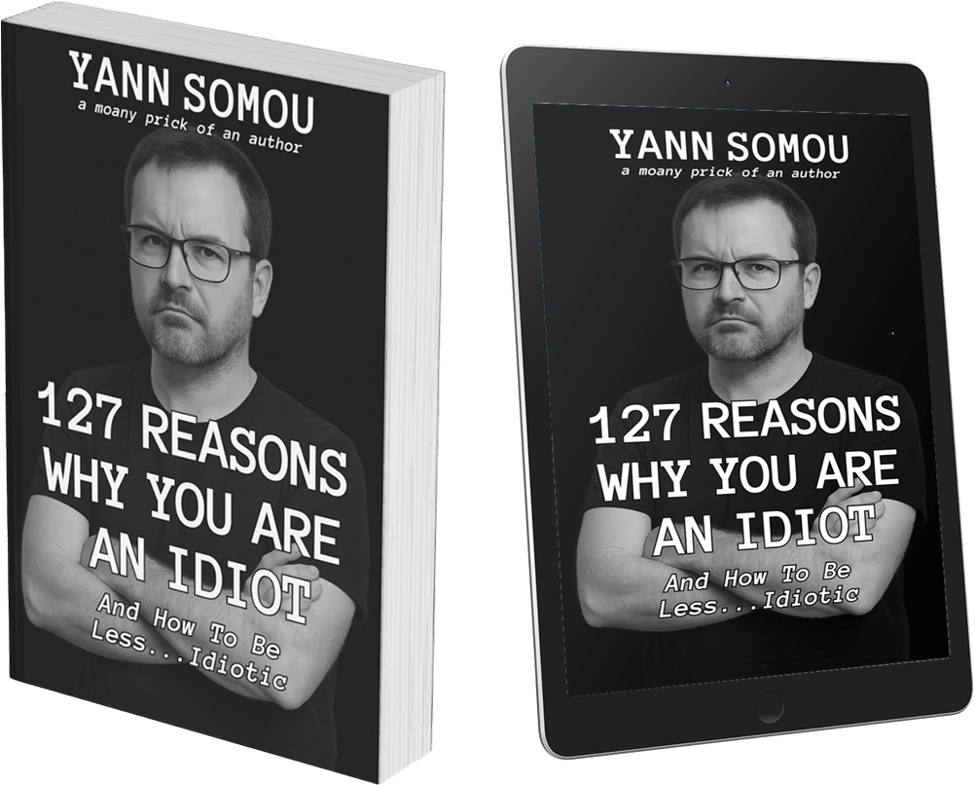
Why not grab a copy of the book that ties it all together, 127 Reasons Why You Are An Idiot! It's chock full of 127 hilarious, sweary, sarcastic, hard-hitting rants about everyday things that everyday idiots do, with quasi-serious, tongue-in-cheek exercises to help idiots be less idiotic.